Sometimes it’s not just the company you keep; it’s how long you keep it.
Credit
TNT with ambition, if not a good grasp of its reach, for trying to
shoehorn the history of the CIA and the Cold War into a six-hour
miniseries. Unfortunately, the project is too short to do its subject
matter justice and too long and clumsy to keep us involved — a
problem compounded by Chris O’Donnell’s boyishly bland performance as TheCompany’s central agent.
CLIP: See what lurks inside ‘The Company’
MORE: Get clued in to TV’s spy legends
Based on Robert Littell’s novel, The Company uses
O’Donnell’s Jack McAuliffe as a witness to CIA history, starting him
off in the agency in the mid-’50s and carrying him through to the fall
of the Soviet Union. He chases spies in Berlin, fights tanks in the
Hungarian Revolution, battles planes at the Bay of Pigs and hunts for
moles in Washington, D.C., yet he never seems to change, mature or even
age.
The performance is so callow, it makes you wonder if it’s meant as some kind of comment on American foreign policy.
O’Donnell
has high-profile support from Alfred Molina as Jack’s mentor and
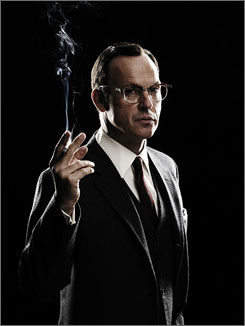
Michael Keaton as James Angleton, the CIA’s real-life head of
counter-intelligence. Chances are you’ll cling to Molina, who gives the
miniseries its few sparks of life as an amusingly bitter but
clearheaded cynic. As for Keaton, you’ll either find his oddly
mannered, tightly contained performance intriguing or, well, odd.
To fit all its history in, The Company splits
itself into three semi-separate movies: the first a spy-vs.-spy
thriller, the second an action/adventure story, the third a paranoid
conspiracy tale. But the attempts to connect the whole ultimately
destroy the parts as the continuing plot threads tying the main
characters together take away from the more interesting historic events
going on around them.
Perhaps because the
miniseries strains to cover so many time periods, none feels lived in
or organic as they do in AMC’s gorgeous paean to Madison Avenue in the
’60s, Mad Men. Here it’s more like kids playing dress-up, with scenes in Russia coming across as a bad spoof of Chekhov.
For those who follow CIA history or who have already seen The Good Shepherd,
the writers take on faith the idea that there was a mole in the CIA to
be discovered and that Angleton’s search, however obsessive, was
justified. The other theory, that there was no mole and he tore the
agency apart out of sheer paranoia, will have to wait for another
miniseries.
There is some amusement to be had from The Company‘s
initial embrace of old-tech spying: the primitive listening devices,
the secret codes hidden in walnuts. But by the time they finally reveal
the KGB’s diabolical plan to destroy the Western world, you may just
think the film has gone from walnuts to plain nuts.
Assuming you’re still around, of course. My advice? Spy out some better company.
Powered by ScribeFire.

 ::Tullycast::